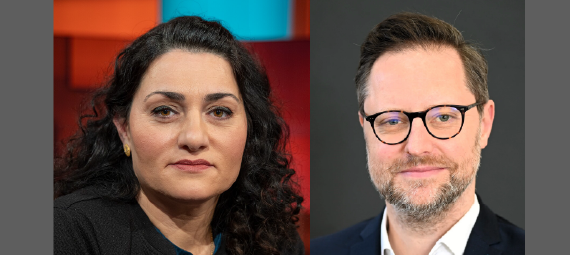
Does cooperation with the Gulf States in the Global South make sense? The BAG Globale Entwicklung held a fascinating workshop on this topic featuring Lamya Kaddor, a Green Party member of the German Bundestag, and Sebastian Sons, a researcher who has been studying the Gulf States’ activities in the Global South for decades. Roger Peltzer has summarized the results of the discussion in the following article.
This summary reflects my view of the discussion’s outcomes. It does not necessarily reflect the views of Lamya Kaddor and Sebastian Sons.
- The Gulf states (the UAE, Qatar, and Saudi Arabia) have undergone tremendous cultural, social, and economic development in recent decades. As a result, the “Gulf Arabs” have become much more self-confident and now assert a leadership role even vis-à-vis traditional Arab powers such as Egypt or, in the past, Syria. Not only has the economic clout of the Gulf states grown enormously, but they have also undergone rapid social development. Saudi Arabia, for example, has opened up culturally and socially and is increasingly distancing itself from the Wahhabism that once dominated the country. Already today, women there enjoy largely equal professional status and are now free to move about on their own, etc. Attendance at movie theaters, music festivals, and similar events is growing rapidly in Saudi Arabia.
- To this day, there are no reliable overall figures on the extent of economic cooperation between the Gulf States and the Global South, which is one reason why the ODA provided by the Gulf States is systematically underestimated. Only recently have Saudi Arabia, the UAE, Qatar, and Kuwait begun to report, at least in part, on their ODA contributions to the OECD.
Economic cooperation with the Global South includes the decades-long commitment of these countries’ development funds or the Islamic Development Bank, extensive humanitarian aid, massive support for infrastructure development in Africa in the field of renewable energy, as well as for ports (DP World), strong support for multilateral health initiatives (GAVI, Global Health Fund), and investments in education. And, of course, it also includes extensive direct investments. The lines between concessional aid and commercial investments are often blurred, which makes it even more difficult to isolate the pure ODA component. However, it is probably safe to assume that the Gulf states currently account for at least 50% of the total amounts the EU is currently investing in Africa, both in terms of ODA and commercial investments.
- The Gulf states have a variety of motives for these investments. Economic interests certainly play a dominant role. For example, one reason the UAE is so heavily involved in Sudan is that it wants access to the country’s gold deposits in order to expand its already dominant role in the international gold trade. Frequent reference is also made to the “land grabbing” by gold-producing nations in Africa, through which they aim to secure long-term access to agricultural products. (Note: However, the actual extent of “land grabbing” is often overestimated in relevant publications. There is a significant gap between announcements, signed letters of intent, and the actual acquisition of land. Much of this land in Africa is already inhabited and farmed, and the displacement of the local population is, in reality, far more complex and difficult than the grandiose letters of intent would have us believe.)
In addition to purely self-serving motives, however, the gold-rich nations often also have an interest in social stability in the Global South and therefore invest, for example, in education and health care as a preventive measure against further developments such as those seen during the “Arab Spring.” Purely humanitarian considerations also play a role in the context of “zakat,” the social contributions prescribed in Islam, and “sadaqah,” voluntary donations.
Overall, however, it is safe to assume that cooperation with the Global South as a whole—which, incidentally, also includes the activities of foundations run by members of royal families—is more or less coordinated from a single source in order to exert influence in the recipient countries.
However, some of the Gulf states in the Global South are also in fierce competition with one another, so that—as in Sudan—the various factions in a civil war can rely on support from different Gulf states.
- What are the implications of the above for Germany and the EU? The Gulf States have become a key player for countries in the Global South—and particularly in Africa—whose significance in economic cooperation often rivals that of the EU. While the Gulf states sometimes exacerbate the problems and conflicts in the Global South (see Sudan), they also make significant contributions to solving global problems in other areas—for example, through investments in the Global Health Fund or Gavi. They have also become one of—if not the—leading players in the development of renewable energy in Africa. Already today, many projects in this sector are no longer funded solely by Western development banks such as the EIB, IFC, KfW, and DEG, but are generally carried out in consortium with financiers from the Gulf states, who often provide the lion’s share of the funding.
In this regard, there are already partnerships between the EU’s “gold states” and Germany, for example in Africa. We need to explore how such cooperation can be expanded on a case-by-case basis without ignoring critical issues, such as arms deliveries by Gulf states to conflict zones or their support for authoritarian regimes.
- How relevant are the EU and Germany as cooperation partners for the Gulf States? First of all, it should be noted that the relative importance of the EU and Germany as cooperation partners for the Global South has declined significantly. The Gulf States are able and willing to advance many of their own projects and political initiatives on their own or, for example, in collaboration with the BRICS countries. The West is often no longer even a factor in these efforts.
On the other hand, however, the Gulf states have also realized during the current war with Iran that the United States cannot be relied upon at all, and that Donald Trump’s erratic policies are causing them major problems, such as the massive destruction of oil production facilities and infrastructure by Iranian missiles. As a result, there is a renewed interest in the Gulf states in cooperating with reliable partners who, to some extent, respect a rules-based world order. The EU and Germany can capitalize on this renewed interest to expand cooperation in the Global South as well.
- Cooperation with the Gulf States on an equal footing. What does that mean?
Germany—but especially the Greens and the “traffic light” coalition government—has placed great emphasis on a “values-based foreign and development policy” in recent years. This culminated, not least, in Interior Minister Faeser wearing an LGBT ribbon during the World Cup in Qatar. This was perceived not only in Qatar but also in large parts of the Arab world as a provocation and a completely inappropriate interference in the host country’s internal affairs. This symbolic act has clearly damaged relations with Qatar, even at the societal level.
As a general rule, the Gulf states will not accept lectures from Germany on the subject of human rights. Any such attempts are quickly rebuffed with the argument that Germany de facto tolerates Israel’s massive human rights violations against the Palestinians. There is hardly any room for discussion on this matter.
If Germany and the EU wish to expand their cooperation with the Gulf States—at least in part—they will have to quickly set aside the “missionary zeal” of values-based foreign policy and instead adopt an approach based on mutual respect, one that first and foremost acknowledges that their partners also pursue different interests and values. Furthermore, it should be noted that the Gulf States do not see themselves merely as financial contributors to development cooperation, but rather as experienced and well-connected partners who wish to be involved on an equal footing in the planning, design, and implementation of projects. In such a strategic partnership, fundamentally characterized by mutual respect, conflicting viewpoints can then also be discussed on a case-by-case basis.
However, this should of course not prevent us from also clearly criticizing, for example, arms shipments from Gulf states to conflict zones and massive land grabbing—if it does occur. Ultimately, the goal is to strike a balance between respectful cooperation, overlapping and divergent interests, and necessary criticism. It’s not easy, but it’s not impossible either.
Cover image: Photos by Lamya Kaddor, © Superbass / CC-BY-SA-4.0 (via Wikimedia Commons) and Sebastian Sons, URL: https://carpo-bonn.org/uber-uns/team/team/dr-sebastian-sons; image rights remain with the copyright holders